
Research partnership for digital Production technologies
Modern manufacturing environments are becoming increasingly complex and require agile and networked systems. The key to success in this environment lies in intelligent data management. This is based on several years of research collaboration with TU Wien, the University of Magdeburg, and, among others, within the framework of a Christian Doppler Laboratory, which enables comprehensive basic research and methodological developments. In addition, findings from the professional exchange in the AutomationML (AML) association and new modeling approaches are taken into account. The results obtained from this are incorporated into the development of the software platform and shape the digital production strategy.
At the heart of this innovation is the “product, process, and resource” (PPR) data model. This structured, networked foundation is changing the way production data is managed and used, and forms the basis for a true digital transformation in manufacturing.
The PPR Foundation: Unifying Your Production Data
The PPR data model provides a holistic framework for your production environment by systematically organizing three core elements:
- Product: Detailed information about what is being produced.
- Process: The sequence of operations and activities involved in manufacturing.
- Resource: The equipment, personnel, and materials used in production.
By linking these elements through a standardized, graph-like data model, the fragmentation often seen in complex manufacturing systems is overcome, leading to a unified and intelligent data basis.
Unlocking Key Advantages for Your Manufacturing Operations
Embracing the PPR data model offers significant benefits, directly impacting efficiency, flexibility, and foresight:
Intelligent Production Planning
Gain enhanced flexibility and efficiency. Connecting product, process, and resource data enables more adaptive and optimized production schedules, responding swiftly to changes in demand or supply.
Maximum Data Utilization
Structured and accessible information forms the basis for advanced analytics and AI-supported applications. The consistent acquisition of knowledge about dependencies and relationships provides a basis for meaningful comparisons of measurement data and for the systematic reuse of development and design knowledge. This enables closed control loops in which insights from production and operation flow back into development, planning, and optimization in a targeted manner. Providing AI systems with better, more meaningful models that are based more on knowledge and less on statistical probabilities.
Digital Twin
Achieve precise simulations, analyses, and optimizations of production processes by combining real and virtual models, with the PPR data model forming the basis for effective virtual commissioning.
Sustainable Process Optimization
Implement data-driven methods to drive continuous improvement and efficient, resource-conserving production. By leveraging structured and connected data, inefficiencies are rapidly identified and addressed. For example, an optimization identified for a specific product on one machine can be systematically traced and applied wherever the same process is used, or to similar products manufactured across all operational sites. This ensures every valuable insight scales effectively, resulting in consistent quality, faster delivery, and improved reliability for you.
Improved Transparency
A uniform data standard enables seamless information exchange between engineering, production, and quality assurance. By consistently maintaining dependencies and relationships across product development, process development, mechanical engineering, and production, traceability across the entire value chain improves, and audits and quality controls are significantly simplified.
Systematic Reuse
Make faster, well-founded decisions based on networked information. By deriving processes and automation solutions directly from product development requirements, a connected information base is created. Feedback from production shows whether similar tasks have already been solved and which solutions have proven effective in practice. This enables informed decisions on whether a new development is needed or if existing, proven concepts and designs can be reused.
PPR and Digital Plant Models: Building the Digital Factory
A central focus of this research involves exchanging engineering data and modeling an adaptable data structure that integrates product, process, and resource information. This foundational work is crucial for developing comprehensive digital plant models, which are essential for realizing the full potential of the digital twin concept in complex production systems.
Objective
A uniform, standardized database enables the intelligent linking and evaluation of production processes.
Implementation
The integration of the PPR data model into our CI4 software platform creates a powerful digital infrastructure for efficient and adaptive manufacturing systems.
Benefit
Companies gain a powerful tool for analyzing, simulating, and optimizing their production environments.
Driving Forward: Research Contributions to Industry Standards
The research efforts supporting the PPR data model are concentrated on several key areas designed to advance manufacturing capabilities:
- System Integration: Networked data models streamline cooperation between development, production, and quality assurance, breaking down traditional silos.
- Optimized Data Structures: Clear and standardized data formats guarantee efficient storage and processing of production data.
- Process Improvement: Continuous optimization of manufacturing processes is achieved through data-driven analysis and insights.
- Standardization and Scalability: These research approaches contribute to establishing new industrial standards, fostering the development of future-proof production technologies that can scale with your business needs.

David Hoffmann from the University of Magdeburg highlights the collaborative value: “Collaborating with STIWA enables us to compare and evaluate current findings from industry and science. The consistent and generic data modeling based on PPR, which is the foundation for the new CI Suit 4 platform, supports model-driven development and opens up numerous application possibilities, for example, for representing the digital twin of a complex production plant. The Chair of Production Systems and Automation (PSA) at the University of Magdeburg plans to integrate this concept and the available tooling into projects and teaching."
David Hoffmann
Research Associate, University of Magdeburg
Practical Applications: Tools Built on PPR approach
The theoretical foundation of PPR is brought to life through practical software tools:
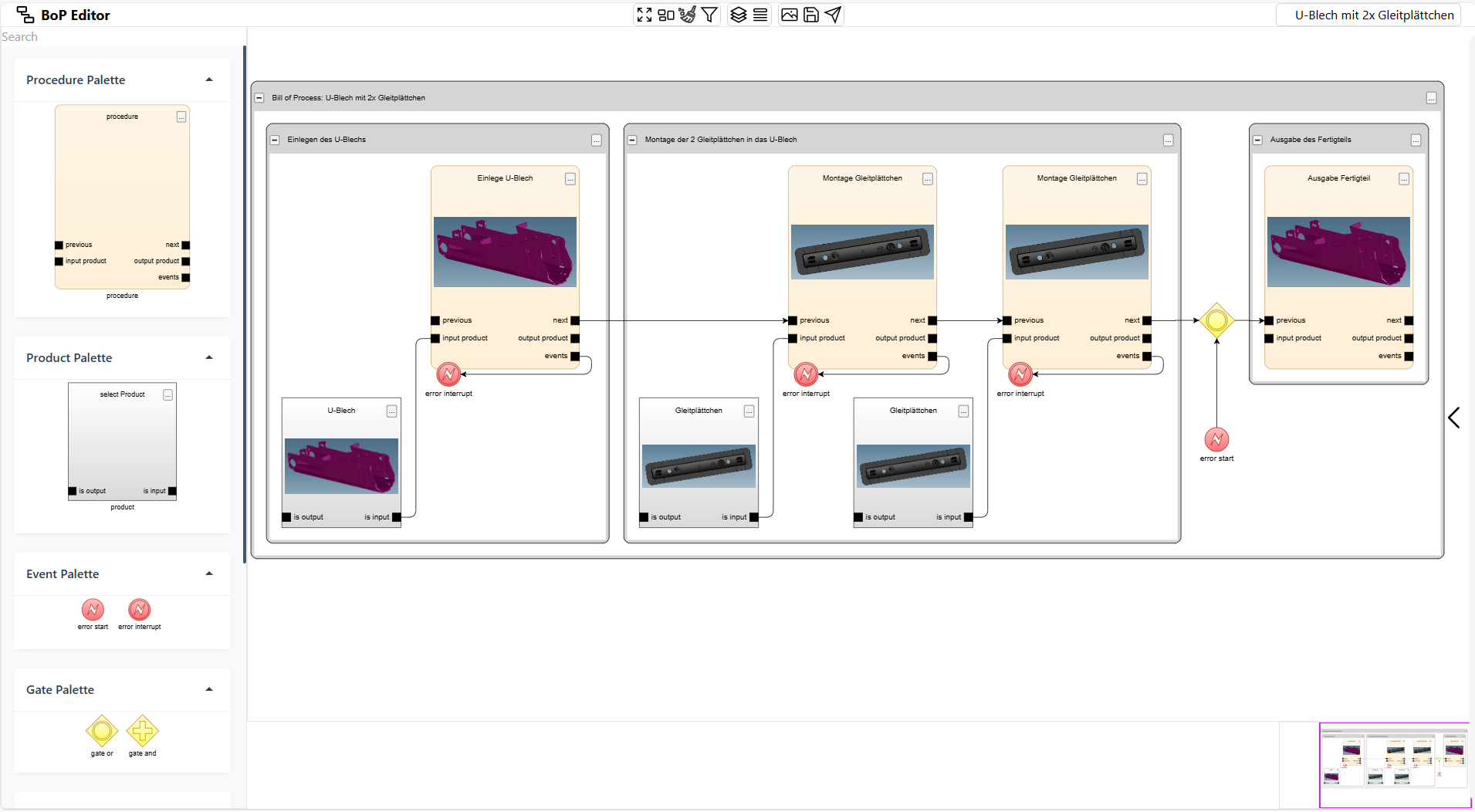
BoP-Editor:
This tool is dedicated to planning and defining assembly processes utilizing a BPMN-oriented approach. It enables the precise management of assembly steps and the creation of Bills of Process, detailing the chronological sequence of operations along with their specific parameters, settings, and process values required to transform individual components into a complete product.
Shape the Future of Your Production
The evolution of digital production hinges on innovative data models. Embracing the PPR data model signifies a commitment to smarter, more efficient, and more sustainable manufacturing. It's a strategic step towards integrating advanced technologies like AI and realizing the full potential of your digital twin initiatives.
Would you like to learn more? We are here for you!