Efficient Series Production at High-Wage Locations Through Intelligent Shopfloor Software Solutions
Manufacturing companies in high-wage regions like Europe face unique challenges in a globalized economy. Their success largely depends on two critical factors: efficiency and productivity. Only through consistent optimization of these factors can lasting competitive advantages be created, especially in highly variable series production.
The Challenge of Modern Manufacturing
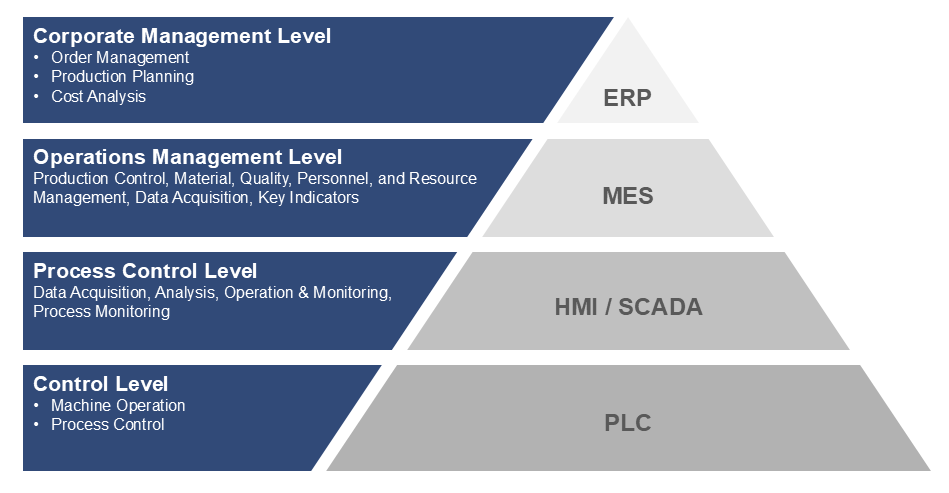
Highly variable series production places specific demands on production systems. As traditional "single-product line concepts" increasingly need to be combined with flexible manufacturing systems, the demand for quality and output also rises. This higher level of agility requires intelligent solutions across all production levels, from the control level to the executive level.
1. Robust System Architecture
A key factor for an efficient production-oriented IT system is the consistent reduction of interfaces. MES architectures that include the level of automation have demonstrated a 35% cost reduction in future machine integrations. A well-thought-out architecture forms the foundation for all further optimizations.
2. Data as a Source of Value Creation
To efficiently run automated processes in series production, it is essential to use all available information. Standardized PLC blocks that can be integrated into the equipment's module sequence meet this requirement. The captured data is available in real-time as a uniform, extensive data set for processing, networking, and analysis.
This data can be used effortlessly for traceability, global production analysis, and ongoing process optimization. When properly networked, they contribute significantly to global production optimization.
This makes it possible, for example, to collect process values not just as a measured value at a specific point, but as a curve of complete force/displacement curves that provide information about the entire process sequence. In addition, this data can be linked to other processes and analysed
3. Fact-Based Control Loops
Closed, fact-based control loops enable continuous improvement in series production by relying on unaggregated data. Decisions are made based on facts, not assumptions. Key questions are answered:
- How, when, and why does a part become scrap?
- Why are process limits not adhered to?
- How is cycle time being wasted?
- What impact does the feed material have on the process and quality?
When this information is available to all relevant personnel, from operators and maintenance staff to quality assurance, the machine ramp-up time can be reduced by 25%. Additionally, equipment efficiency can be increased by up to 15% and maintained consistently.

Practical Examples
Real-Time Process Monitoring
Modern monitoring solutions go far beyond statistical evaluations or simple visualizations. Networked process monitoring that continuously captures and analyzes data supports machine operators, quality controllers, and process engineers.
The graphical representation of measurement data for regular employees, not for data scientists, enables intuitive operation. Effects of machine or recipe parameter changes become immediately visible. Early warning systems can prevent the production of scrap before it occurs.
Analysis at All Levels
For production managers, it's crucial to always have an overview of systems and output. Web-based solutions offer simple KPI dashboards for all production equipment per production area and provide access to detailed KPIs of the current shift and order information.
Visualizations of equipment status on shop floor overviews and the availability of historical production data ensure continuous visibility of distributed production areas. Online access and mobile notifications enable short feedback loops for production optimization and fast responses to machine downtime.
Conclusion: The Path to Efficient Production
A well-designed architecture that utilizes all available data and employs fact-based control loops is the key building block for efficient production at high-wage locations.
STIWA Shopfloor Software offers precisely these intelligent, networked solutions that companies need to succeed in global competition, especially at high-wage locations like Europe
Would you like to learn more? We are here for you!