Introduction
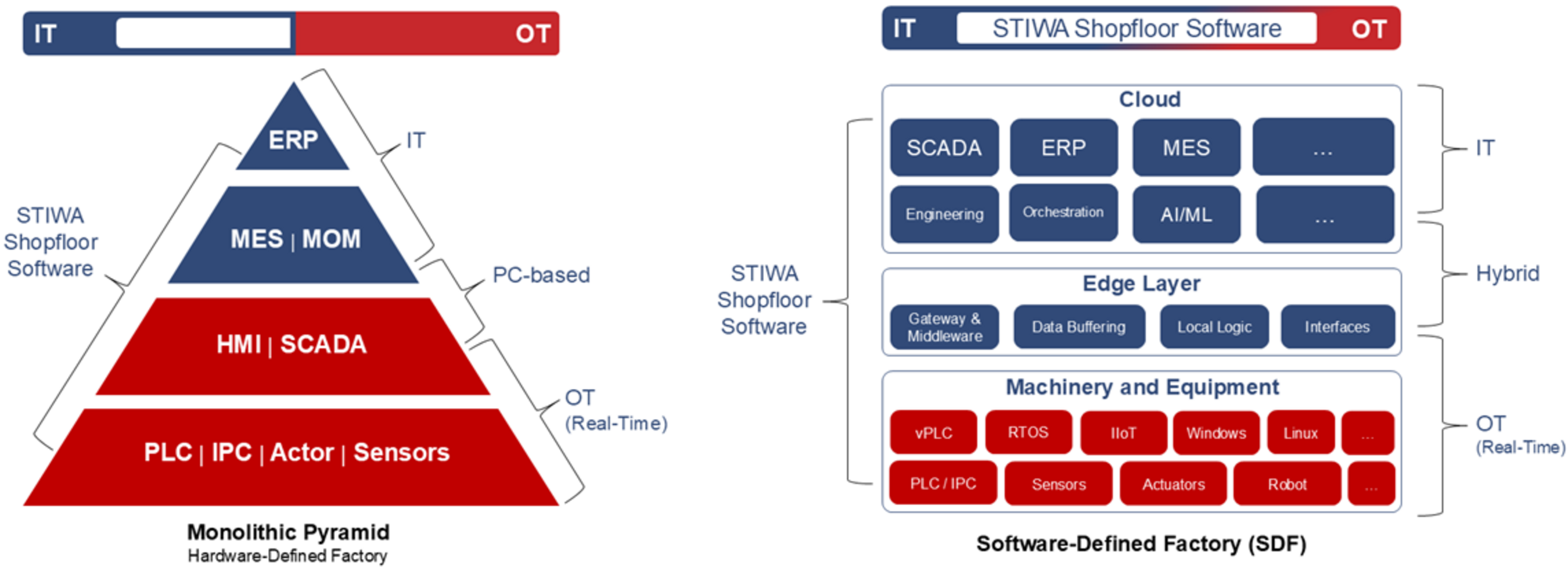
The Industrial Internet of Things (IIoT) has become a transformative force in modern manufacturing, promising unprecedented levels of efficiency, productivity, and granular process optimization. However, realizing this potential often encounters significant hurdles, primarily centered around data integration. Connecting a diverse array of operational technologies (OT), such as industrial machines, sensors, and control systems, with enterprise information technology (IT) systems typically necessitates the use of middleware. While middleware aims to bridge these disparate environments, it can introduce architectural complexity, increase implementation and maintenance overheads, and potentially create latency in critical data flows. This article explores how STIWA Shopfloor Software addresses these architectural and operational challenges with a distinctive design philosophy focused on direct connectivity and embedded intelligence.


Key Features and Architectural Advantages of STIWA Shopfloor Software in the IIoT Context:
- Native PLC Data Integration Without Conventional Edge Device or Middleware:
STIWA Shopfloor Software is engineered for native, deep data integration, operating directly at the machine and controller levels. This architectural design enables real-time acquisition of PLC data (or other machinery equipment) directly at the edge. Instead of relying on a separate, conventional middleware layer, STIWA's software integrates the essential protocol handling, abstraction, and translation capabilities directly into its core. This approach streamlines the data path, significantly reduces overall system complexity by eliminating the need for an additional middleware product, and minimizes data acquisition latency. This direct and integrated interaction is particularly crucial for high-frequency process data and the precise control required in critical manufacturing operations, ensuring superior data fidelity and immediacy. This forms a robust foundation for subsequent analytics and decision-making.
The software's data collection agents are typically deployed as Windows Services or Docker containers directly on the machines' Industrial PCs (IPCs), ensuring maximum proximity to the data source. In addition to this edge intelligence, centralized components, responsible for aggregation, deep analysis, and long-term data storage, reside in secure server rooms or cloud environments, offering flexibility and scalability for consolidated data management across the global enterprise. - Adaptive Connectivity for Heterogeneous Manufacturing Environments:
The software's architecture supports adaptive integration across diverse production landscapes. This encompasses both the seamless incorporation into existing facilities ("brown-field" scenarios) and the deployment within newly designed, highly networked production lines ("green-field" scenarios). Its modular structure and well-defined interfaces facilitate straightforward integration with higher-level IT systems such as Enterprise Resource Planning (ERP), Manufacturing Execution Systems (MES), Computer-Aided Quality (CAQ), and various machine controllers. A key component is the universal line control system, which standardizes machine operation across a heterogeneous fleet, thereby enhancing overall process reliability and reducing complexity in the PLC code, since complex data management and decision-making are handled on STIWA's side. - Inherent Scalability and Future-Proofing Through Modular Design:
The modular architecture of STIWA Shopfloor Software is fundamental to its inherent scalability. The solution is designed to expand from initial installations on individual machines to complex, globally distributed production networks. This is achieved through the incremental integration of additional modules and functionalities as needs evolve. This architectural paradigm ensures flexible adaptation to changing operational requirements and technological advancements, eliminating the need for a complete system overhaul and safeguarding long-term investment. - Embedded Cybersecurity for Robust Machine Communication:
Secure machine communication is a non-functional yet critical requirement, integrated into the system's design. In an increasingly interconnected industrial landscape, where sensitive operational data and control commands are exchanged, STIWA Shopfloor Software implements robust mechanisms to ensure data integrity, confidentiality, and authenticity. This directly addresses the need to protect production processes from unauthorized access and potential cyber threats, solidifying a resilient IIoT infrastructure. - AI- and ML-Driven Process Analytics for Informed Decision-Making:
Beyond mere data acquisition and visualization, STIWA Shopfloor Software integrates functionalities that enable the detection of anomalies, precise identification of bottlenecks, and the data-driven optimization opportunities within complex production processes. The direct, availability of real-time data, is a technical prerequisite for recommendations derived from advanced analytical AI and ML models. - Consolidated Data Foundation for Comprehensive Transparency and Root Cause Analysis:
A central feature of the software's capabilities is establishing comprehensive transparency across all levels of the shop floor. Automated, cross-system, real-time data collection of process, machine, and quality data effectively breaks down traditional data silos. This consolidated data foundation is pivotal for improved root cause analysis of production delays, machine downtime, and quality issues. It thus forms the reliable basis for informed, data-driven decisions and continuous process improvements, transforming raw data into actionable intelligence.
Conclusion
By implementing an architectural philosophy that prioritizes direct, secure, and intelligent data integration, STIWA Shopfloor Software offers a compelling alternative to traditional IIoT solutions that rely heavily on additional middleware devices. This integrated approach reduces complexity, improves data quality and timeliness, and enables scalable, future-proof production.
A scalable IIoT architecture should simplify data access, reduce integration effort, and create a reliable foundation for analytics, automation, and future digitalization initiatives. To delve deeper into the technical specifics of STIWA Shopfloor Software's IIoT integration capabilities or to discuss how this approach can optimize your manufacturing operations, we invite you to contact our experts for a detailed consultation.

Would you like to learn more? We are here for you!