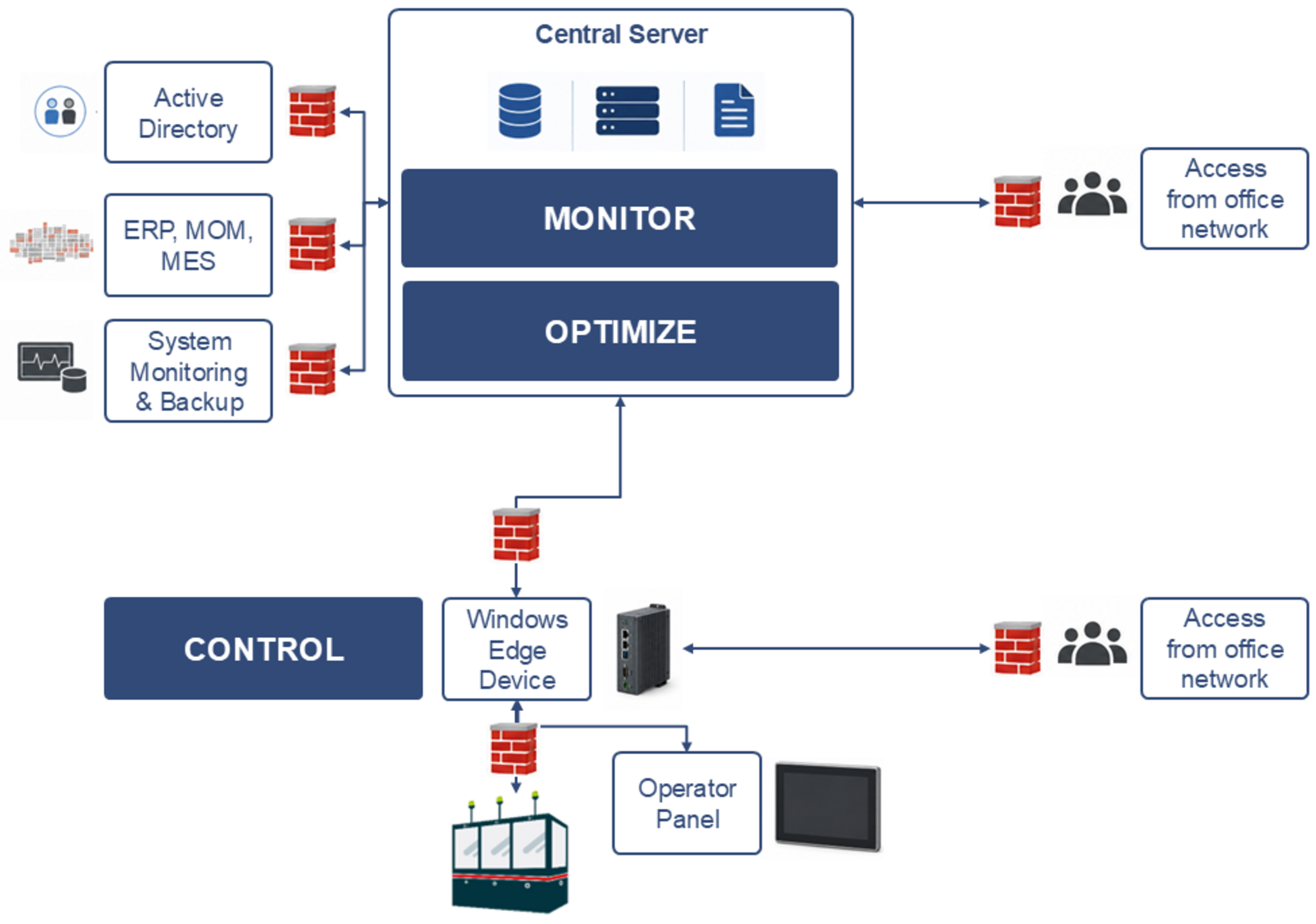
Modern manufacturing facilities are data powerhouses. Every machine, every sensor, and every step in the production process generates a flood of information from tiny temperature fluctuations to complex quality metrics. This data holds the key to efficiency improvements, predictive maintenance, and next-level quality control. However, effectively harnessing this data presents a significant challenge: how do you manage the sheer volume while ensuring both real-time operational agility and long-term strategic insight? The answer lies in a sophisticated approach known as the Hybrid Edge.
Jensen Huang, founder and CEO of NVIDIA, mentions edge computing in his quarterly reports, underscoring its growing importance.
"Agentic AI has arrived, doing productive work, generating real value and scaling rapidly across companies and industries. NVIDIA is uniquely positioned at the center of this transformation as the only platform that runs in every cloud, powers every frontier and open source model, and scales everywhere AI is produced—from hyperscale data centers to the edge."

The Data Flood on the Shop Floor: A Double-Edged Sword
On one hand, this explosion of data offers unparalleled opportunities for optimization. On the other hand, it creates a dilemma. Critical production processes demand immediate action, often within milliseconds, based on local data. Sending all raw data to a central cloud for processing before any action can be taken introduces unacceptable latency. Yet, without centralized data, achieving a comprehensive, holistic view of your entire operation, training advanced AI models, or performing historical trend analysis becomes impossible. This is where the Hybrid Edge steps in, offering a balanced and powerful solution.
The Strengths of Local Edge Processing: Operational Intelligence at the Source
Imagine a critical machine on your production line. It's generating data about vibrations, temperatures, pressure, and throughput. For real-time fault detection or immediate process adjustments, you can't afford to wait for this data to travel to a distant cloud server, be processed, and then have instructions sent back. This is where local edge devices shine.
Edge computing brings processing power directly to the source of data, right next to your machines and sensors on the shop floor.
- Near-Zero Latency: Edge devices allow for immediate data analysis and action. This is crucial for applications such as real-time quality control or rapid fault detection where even a few milliseconds of delay can lead to slower machines or downtime.
- Reduced Bandwidth Costs: Not all raw data needs to be sent to the cloud. Edge devices can filter, aggregate, and process data locally, sending only relevant insights or compressed datasets upstream. This significantly reduces network traffic and associated costs.
- Offline Capabilities: In scenarios where network connectivity to the cloud might be intermittent, edge devices ensure that critical local operations continue uninterrupted, maintaining production continuity.
By handling the immediate, time-sensitive demands, edge computing provides the foundational "operational intelligence" needed to keep production running smoothly and efficiently.
The Power of Centralized Data Storage and Analytics: Strategic Insights for the Enterprise
While edge devices excel at local, real-time tasks, a centralized system, typically a cloud platform or a robust on-premises data center, is indispensable for higher-level strategic analysis and long-term data management. This central repository transforms aggregated edge data into actionable business intelligence.
- Big Data Analytics: A centralized platform allows you to combine data from multiple machines, production lines, or even different plants. This enables comprehensive analysis to identify overarching trends, patterns, and correlations that are invisible at the level of individual machines.
- Long-Term Archiving: Compliance requirements, historical performance analysis, and continuous process improvement often necessitate long-term storage of production data. Centralized systems offer scalable and secure solutions for this.
- Machine Learning Model Training: Advanced AI and ML models require vast datasets for training. These models, once trained centrally, can then be deployed back to the edge devices for real-time inference, creating a powerful feedback loop.
- Enterprise-Wide Visibility: Centralized dashboards and reporting tools provide management with a holistic view of manufacturing operations, enabling informed strategic decisions across the entire organization.
The central component provides the "strategic intelligence" that drives continuous improvement, innovation, and long-term competitiveness.
Bridging the Gap: How the Hybrid Edge Works
The true genius of the Hybrid Edge lies in its ability to seamlessly integrate these two powerful paradigms. It's not about choosing between edge and cloud; it's about leveraging the strengths of both in a cohesive data architecture.
The data flow typically looks like this:
- Raw Data Generation: Machines and sensors generate a constant stream of raw data.
- Edge Processing: Local edge devices capture this data, perform initial processing, filtering, and real-time analysis. Critical actions are triggered immediately at this level.
- Intelligent Data Transfer: Only filtered, aggregated, or critical summary data is then securely transmitted to the central storage. Decisions on what to send are based on predefined rules, bandwidth availability, and the analytical needs of the central system.
- Centralized Analysis & Storage: The central platform stores this refined data for long-term archiving, performs deep analytics, trains sophisticated ML models, and provides comprehensive reports and dashboards.
- Model Deployment (Edge Intelligence): Newly trained ML models or updated business logic can then be deployed back to the edge devices, enhancing their local intelligence and autonomy.
This symbiotic relationship ensures that you have agility where you need it most (on the shop floor) and depth of analysis where it provides the most strategic value (at the enterprise level).
What an Effective Hybrid Edge Architecture Should Deliver
A successful Hybrid Edge architecture is not about choosing between local processing and centralized data management. The greatest value comes from combining both approaches, allowing manufacturers to respond in real time while continuously improving production through enterprise-wide analysis.
An effective solution should provide:
- Real-Time Decisions Where They Matter Most
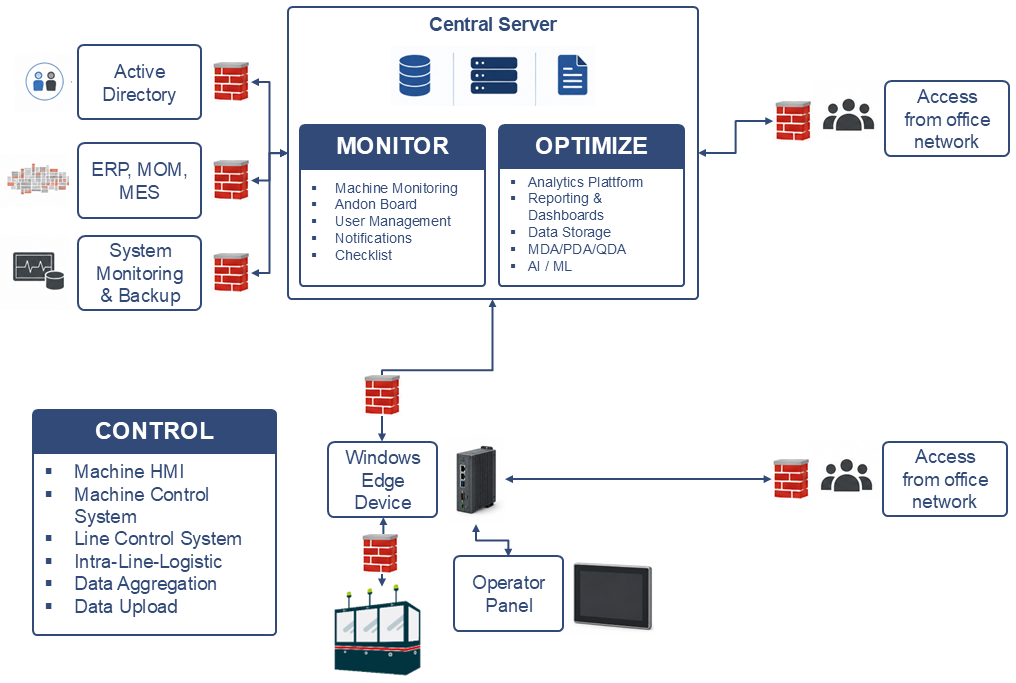
- Time-critical processes such as order lists, machine control, quality monitoring, alarm handling, and recipe provision should be processed locally. Running these functions close to the machine minimizes latency, keeps production running even during network interruptions, and enables immediate reactions to changing production conditions.
- Centralized Data for Long-Term Optimization
- While operational decisions happen locally, production data should still be available centrally for historical analysis, cross-site comparisons, and continuous improvement initiatives. A centralized data platform creates the transparency needed for strategic decisions across multiple production lines and plants.
- For smaller installations or proof-of-concept projects, many of these analytical functions can initially run locally. As production environments grow, centralized architectures unlock significantly greater value through plant-wide and enterprise-wide insights.
- Seamless Synchronization Across the Entire Production Environment
- The real strength of a Hybrid Edge architecture lies in the seamless exchange between local and central systems. Production data, machine states, quality information, and analytical models should move securely between both environments, ensuring consistent information while allowing every layer of the manufacturing system to operate where it is most effective.
How STIWA Shopfloor Software Supports This Architecture
The software collects and processes machine data directly at the production equipment for immediate operational decisions while simultaneously making relevant production information available centrally for advanced analytics, reporting, and long-term optimization.
Rather than forcing manufacturers to choose between edge and centralized computing, the architecture combines both approaches, enabling responsive shop floor operations together with enterprise-wide production intelligence.
Conclusion: Smarter Decisions at Every Level of Production
The Hybrid Edge isn't just a technology trend; it's a strategic imperative for discrete manufacturers aiming to thrive in an increasingly data-driven world. By intelligently distributing data-processing capabilities, you gain unparalleled machine-level agility and comprehensive enterprise-level intelligence. This approach not only future-proofs your operations for Industry 4.0 but also empowers you to make smarter, faster, and more informed decisions across every facet of your production.
Ready to optimize your data flow and gain a competitive edge? Discover how STIWA's hybrid edge solution can transform your data strategy. Contact us for a personalized consultation on intelligent data management.