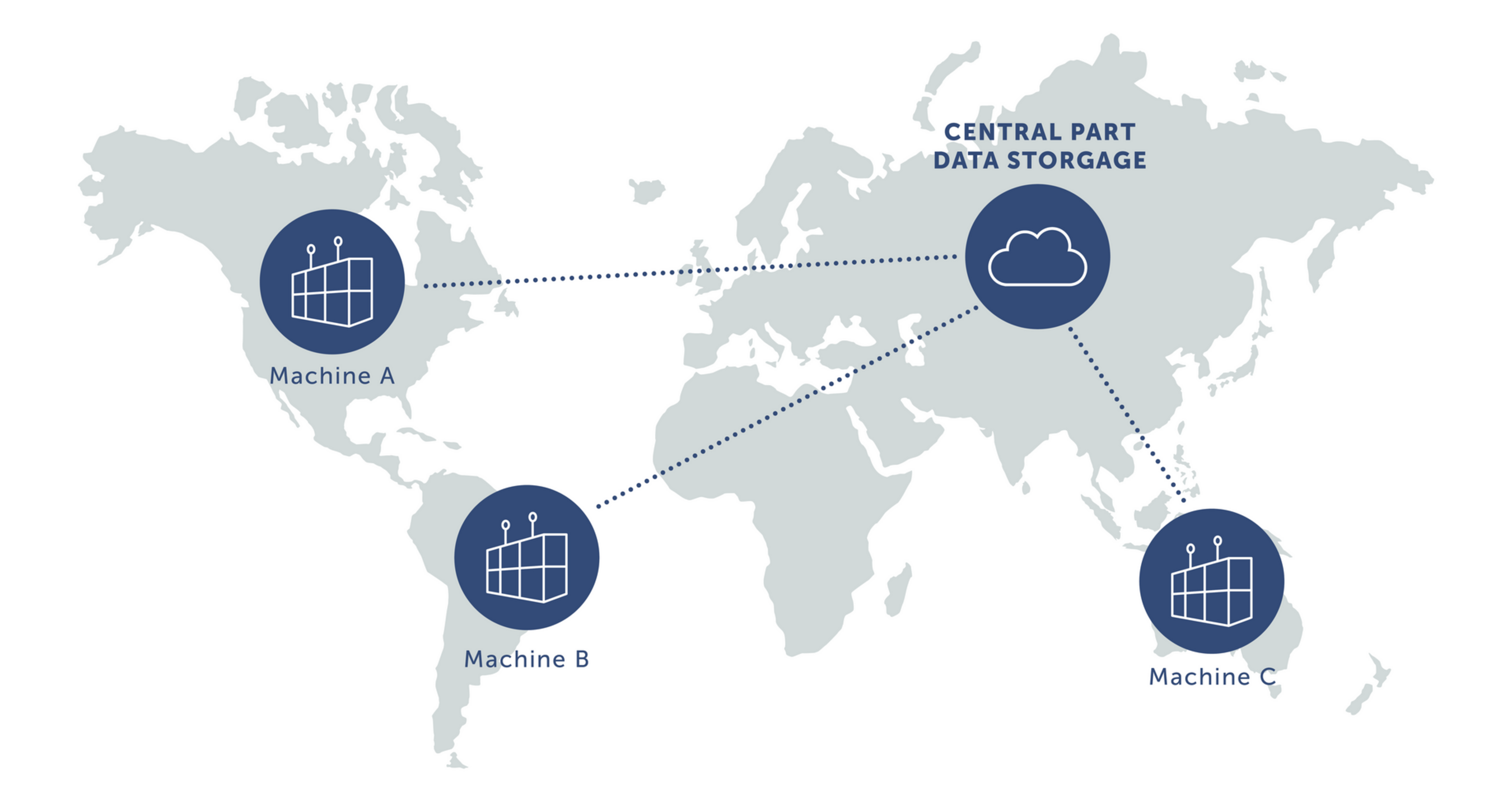
In high-volume manufacturing, even the smallest error can snowball into massive costs. A single mis-assigned production part data point can trigger recalls worth millions. That is why more manufacturers are turning to Machine-to-Machine (M2M) communication: automated data exchange between machines that makes production not only faster but also safer and more reliable.
Why M2M Matters
In today’s distributed production environments, components often travel across multiple machines, plants, or even continents. Without a consistent flow of data, errors slip in: wrong parts, missed checks, and broken traceability.
M2M solves this by assigning a “data backpack” to every part, which travels with it. All product and process information, such as tolerances, test results, and assembly status, is available exactly where it is needed. That makes adaptive manufacturing possible. Downstream machines automatically adjust based on the quality or condition of incoming parts.
Key enablers include:
- Automatic part identification via RFID, smart labels, or barcodes
- Clear data assignment at every process step
- A combination of central and local storage to ensure resilience and uptime
- Integration with plant control centers and MES for end-to-end visibility
This is not just IT. It is production intelligence built into every step of the line.
Direct Impact on Production
M2M creates measurable improvements where they matter most:
- No more guesswork: Only the right component, in the proper condition, moves forward. Manual errors are eliminated.
- Early defect detection: Parts flagged as defective are removed before they create further issues. Blocklists enable the tracking and exclusion of faulty deliveries.
- Fewer recalls and lower costs: Problems are caught in the line, not in the field. That means avoiding costly recalls and damage to reputation.
- Faster throughput: Machines adapt automatically to variations in raw materials within tolerance. Processes do not stall for manual adjustments.
- Less testing, lower investment: Upstream measurement data is reused, eliminating redundant testing and reducing the need for costly measuring equipment.
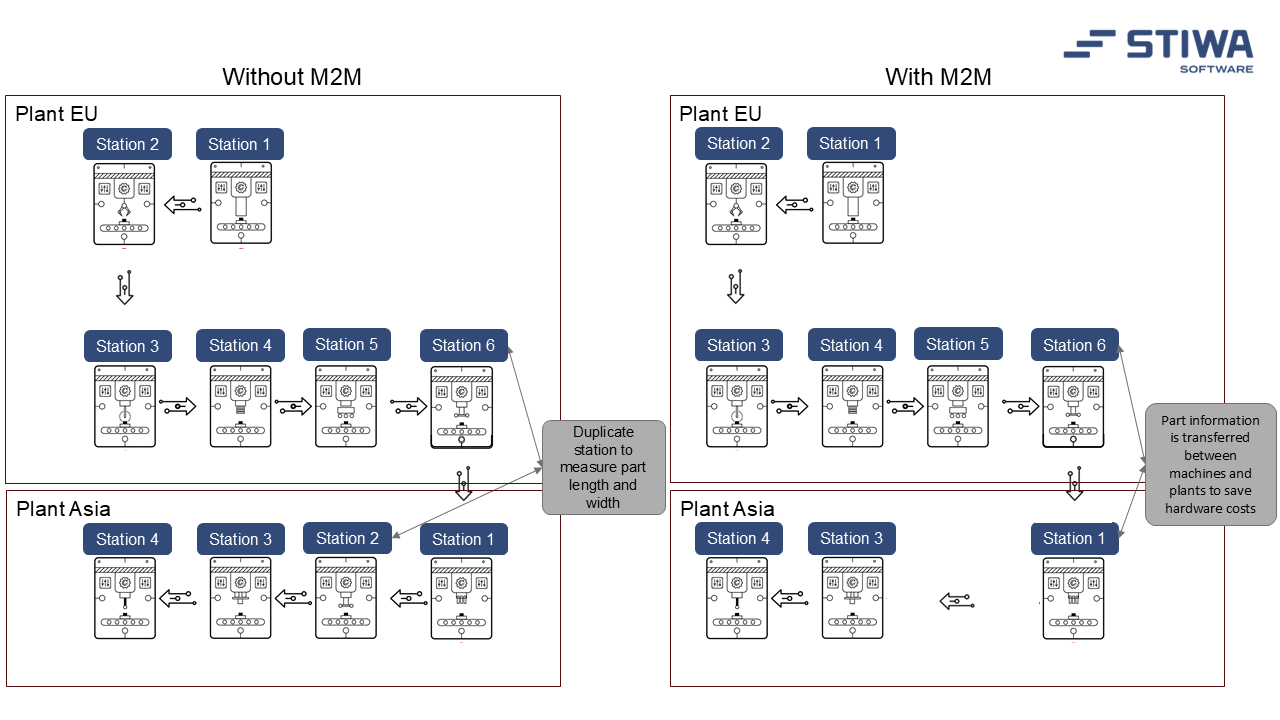
One machine concept utilizes a dedicated measuring station in its Asian plant to determine part length and width, information vital for subsequent processing. The alternative machine concept, leveraging M2M communication, eliminates this physical station. Instead, critical part information is digitally transferred to Asia, effectively traveling with the part as a "data backpack." This not only removes the need for redundant measurement infrastructure but also significantly reduces costs by enabling adaptive manufacturing without additional physical checks.
Economic Advantages
Beyond quality and reliability, M2M creates direct economic benefits:
- The use of cheaper pre-components with larger tolerances without sacrificing end quality
- Shorter production cycles thanks to fewer measurement steps and reduced rework
- Less scrap and more usable output
- Reduced risk of faulty delivery: Since every component carries complete process data, defective parts are identified at the production source rather than after End-of-Line, directly addressing the core need for reliable production equipment
- Eliminated redundant measurement infrastructure: By sharing measurement data across the production line, manufacturers avoid duplicate testing stations and quality control checkpoints that were previously necessary to ensure process completion, reducing both capital investment and operational overhead
Challenges to Address
Like any transformation, M2M has hurdles. If data is assigned incorrectly, defective parts slip through. If databases or networks are too slow, production slows or stops. And if systems depend on one IT hub, a single point of failure can bring everything down.
The solution is resilient architectures that combine local and central data storage, user-friendly interfaces to manage complexity, and proven software modules designed for high availability.
Built on Real Production Experience
Many software providers promise efficiency, but their solutions are designed from an IT perspective alone. M2M solutions here are different. They are born out of real production environments, tested on high-performance automation lines where scrap, downtime, or recalls are not an option.
That production DNA means every feature is grounded in the realities of running complex, high-volume manufacturing. It is software that connects machines beyond just their physical components. It connects manufacturing goals with shop floor execution.
The Takeaway
With M2M communication, every part is traceable, every process step is verified, and costly errors are caught before they happen. The result is fewer recalls, lower costs, faster ramp-up, and consistent quality across even the most complex global production networks.
This is not just a more innovative way to run machines. It is peace of mind in a market where one mistake can cost millions.
Would you like to learn more? We are here for you!