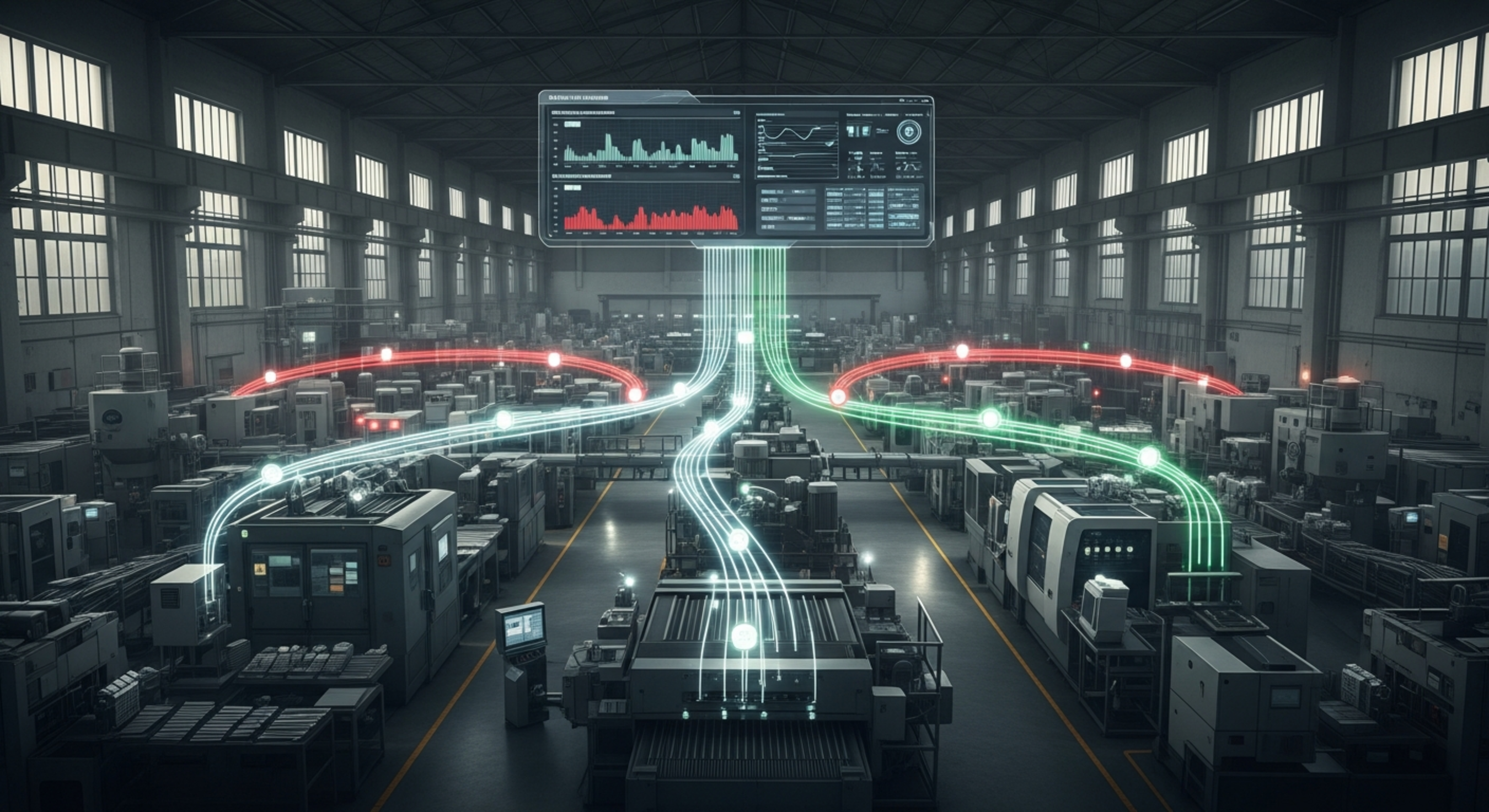
In manufacturing landscapes, companies face a seemingly paradoxical problem: although individual machines run robustly and reliably, actual production output often deviates from target requirements. Why does an operator consistently produce 1,100 units when the customer only ordered 1,000? The answer often lies in entrenched structures, lack of transparency, and fear of production stoppages. This article sheds light on the challenges of old, non-networked equipment and shows how Lean Management and Continuous Improvement (CIP), supported by the right technology, can lead to significant production optimization.
The “100-Product Trap”: More Than Just a Number
The assumption that an operator simply “plays it safe” and produces 100 extra products is widespread. But this overproduction is not a harmless safeguard it’s a clear sign of deep inefficiencies and hidden costs. The “extra” units not only need to be stored, tying up capital. They also cause additional effort for:
-
Sorting and separation: The 100 surplus units often have to be manually removed if the desired customer quality isn’t met, or they’re simply not needed. This costs time and manpower.
-
Logistics and handling: Every unnecessarily produced item must be transported, stored, and managed.
-
Rework or disposal: If products don’t meet quality standards, costs arise for rework or even for scrapping defective items.
-
Labor and energy costs: Every additional product consumes material, energy, and workforce capacity.
-
The fact that overproduction is tolerated or even desired is rooted in the fear of not meeting production targets. The goal must be to align operations so that failures and quality deviations don’t occur in the first place.
The Starting Point: Entrenched Structures and Lack of Connectivity
Many manufacturers struggle with infrastructures that have developed over decades:
-
Old and non-networked machines: Individual machines are often robust and perform well on their own but are not connected with each other.
-
Stepwise procurement: Modular units have been added over time, sometimes with different technologies from different manufacturers. The result: a heterogeneous equipment landscape.
-
No standardized software: This leads to data silos and makes cross-machine data collection for optimization and analysis difficult.
-
This fragmented system landscape prevents transparency across the entire process. Where are the bottlenecks? Which processes are unstable? Without machine and real-time data, it is impossible to assess the true performance and efficiency of the equipment.
Lean Management & CIP: The Path to Process Mastery
This is where Lean Management and the Continuous Improvement Process (CIP) come into play.
-
Lean Management is a holistic approach aimed at eliminating all waste in production that does not add value for the customer. The focus is on making processes leaner, faster, and more customer-oriented to maximize efficiency gains.
-
Continuous Improvement Process (CIP) is the engine driving this transformation. CIP is the philosophy that improvement is not a one-off project but a continuous cycle. The idea is to constantly make small adjustments and optimizations. When you say, “I finish today and start with a new topic tomorrow,” that describes the iterative nature of CIP: constantly identifying, analyzing, and solving problems. This helps address production bottlenecks by tackling root causes, not just symptoms.
The Role of Deep Process Understanding and Data
-
The foundation for precise production lies in robust processes. These are achieved through careful planning and the involvement of all departments and suppliers to align specifications. As part of this, it is worth conducting a Failure Mode and Effects Analysis (FMEA) with all stakeholders. This method allows potential sources of error to be ruled out early on. At the same time, measurement points for process monitoring can be identified and planned.
-
A deep understanding of processes is essential, achievable only through close analysis and observation. This also makes it possible to upgrade or retrofit older equipment. Such analysis also reveals where predictive maintenance makes sense.
-
The objective: align operations so there are no breakdowns or quality deviations. Coupled with the right measurement and monitoring points, deviations in quality or output can be detected early. Fixing issues at this stage is far cheaper than dealing with problems once products have already reached the customer.
How Software Boosts Your Lean and CIP Initiatives
Digitization is not an end in itself, but a powerful enabler for Lean and CIP. How software specifically supports this:
-
Connecting legacy machines: Even existing equipment can be integrated with modern sensors and software. This turns isolated machines into connected systems that capture valuable data.
-
Detecting disruptions/deviations: Centralized data collection makes it possible to identify disruptions, quality deviations, and inefficiencies in real time.
-
Predictive Maintenance: Based on captured data, maintenance can be planned proactively, increasing equipment availability and avoiding stoppages. The more reliable your machines, the lower your lead times and buffers resulting in optimized cycle times.
-
Reducing scrap & ensuring quality: Precise data collection and analysis make it possible to identify and eliminate error sources, reducing scrap and elevating quality assurance.
-
Tackling workforce challenges: Standardized data collection and visualization create transparency and reduce dependency on individual employees. Processes become easier to understand and control, making workforce transitions more manageable.

Your Path to Optimal Manufacturing
Digital transformation on the shop floor is not a luxury, it’s a necessity. It helps you move from fear of overproduction to data-driven, lean manufacturing.
Do you want to identify problem areas in your production, analyze root causes, and define the right measures for optimization?
To develop a deep process understanding and strategically set up your Lean and CIP initiatives, external expertise is often invaluable. Contact Holger from Thieringer Consulting. He is your partner for designing and implementing sustainable change processes.
Are you looking for the right technological solutions to monitor problem areas, optimize your equipment, and solve quality issues?
For digitizing production and integrating existing equipment, STIWA Software is the right partner. We provide proven standard products, tailored to the needs of lean and efficient manufacturing processes. Contact Philip Privalov from STIWA Software. He will gladly advise you on the software solutions that can digitize your production and increase your efficiency.


Would you like to learn more? We are here for you!