Digitization: A million-dollar grave or a real competitive advantage
Find out what you should have done, what others are doing, and what's next. You'll see how leading companies are increasing their efficiency.
Watch time: 22:15 min
Welcome to a critical discussion on digitalization in manufacturing. In an era defined by rapid technological advancements, many companies grapple with a fundamental question: Is investing in digitalization merely throwing money into a bottomless pit, or is it a genuine pathway to sustainable competitive advantage?
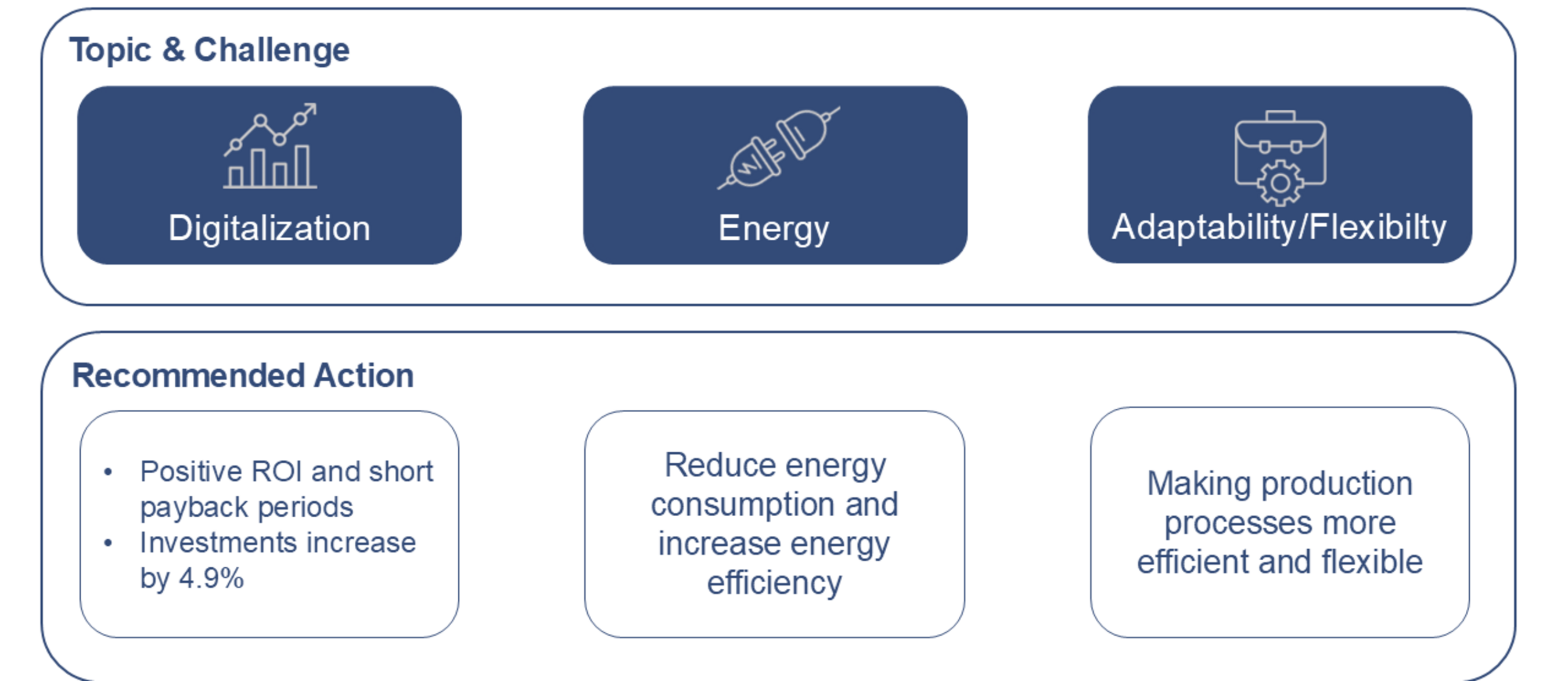
The short answer is yes, it can. Findings from the DACH region (Germany, Austria, Switzerland) indicate that companies that invest in digital technologies often achieve a positive return on investment (ROI). According to an IDC study, investment in information and communication technology in the DACH region is expected to grow by 4.9% in 2023, with further growth expected in subsequent years. In the EMEA region, spending on digital transformation (DX) will grow by an average of 15.8% per year between 2024 and 2028. This trend demonstrates a strong commitment to digital transformation, even amid economic uncertainty, as companies recognize its importance for long-term competitiveness.
Digitalization should not be pursued for its own sake, or simply because management has allocated a budget. The key lies in strategic implementation; it is a powerful tool for securing long-term business success and must be applied meaningfully.
Beyond ROI, digitalization addresses several pressing challenges:
Ultimately, investments in digitalization continue to pay off and are essential for maintaining a competitive edge.
To understand where a company should ideally be in its digitalization journey, it's helpful to consider the automation pyramid, which illustrates the architecture of hardware and IT systems.
At the top is IT (Information Technology), encompassing traditional computers and software. At the bottom lies OT (Operational Technology), which includes the hardware and machinery responsible for physical processes. Where the actual work of welding, screwing, and drilling takes place. The crucial point is the seamless integration of OT and IT.
Central systems such as ERP (Enterprise Resource Planning), MOM (Manufacturing Operations Management), and PLM (Product Lifecycle Management) sit at the pinnacle of this integrated structure. These systems are increasingly blurring their boundaries, highlighting the need for holistic integration.
Today, companies should have already digitized their core business processes, including inventory management, order processing, logistics, finance, human resources, and procurement. Below this, MES (Manufacturing Execution Systems) are critical for data acquisition, analysis, workflow, and resource management.
The data from the MES needs to reach the shop floor. This includes not just order data but also process data, such as measurement values and process interlocks. For instance, parts should not be fully assembled if they haven't completed all necessary process steps, especially when these steps aren't visually apparent (e.g., drying times for adhesives, thermal processes).
The most vital aspect is that all systems are interconnected and actively utilized.
While digitalization offers immense potential, many companies fall into common traps that turn their investments into "money pits" rather than competitive advantages. If any of these points resonate with your organization, immediate action is recommended:
If one or more of these points apply to your company, proactive engagement is strongly advised.
Looking ahead, several key areas demand attention to ensure sustained digital success:
If you're looking to deepen your understanding or strategize your digital implementation.
STIWA Software offers:
Product Deep-Dives: For a detailed look into specific solutions.
Digitalization is not a matter of choice but a necessity for competitive survival and growth. By addressing the pitfalls and strategically implementing advanced solutions, companies can truly unlock the competitive advantages it offers. This article, inspired by a 2024 webinar (only in German) available below, explores this dilemma, offering insights, pitfalls to avoid, and practical recommendations for industrial enterprises.
Find out what you should have done, what others are doing, and what's next. You'll see how leading companies are increasing their efficiency.
Watch time: 22:15 min
Would you like to learn more? We are here for you!