The cloud has long ceased to be a niche topic; it is the backbone of modern business models. However, for many European companies, especially SMEs and those in the manufacturing industry, the benefits of global hyperscalers have always been contrasted with data protection concerns and questions of digital sovereignty, fueled by the US CLOUD Act. Major cloud providers including Microsoft, AWS, and Google have recognized that the demand for digital sovereignty will not subside. They are responding with "Sovereign Cloud" initiatives, offering data residency exclusively within the EU, local operating models, and contractual assurances against external access.
But do these approaches truly resolve all concerns? Or are there still valid reasons to opt for purely European providers, or even to pursue a hybrid strategy? The following article explores the landscape of European cloud alternatives and helps you make the right decision for your company.
Who Needs a Sovereign Cloud and Which Industries Are Affected?
Any organization dealing with sensitive, regulated, or business-critical data should consider a Sovereign Cloud strategy. It's no longer just a question of "Cloud yes or no?", but "Which cloud for which data?".
The need usually arises for one or more of the following reasons:
- Legal and Regulatory Requirements: Clear mandates on where and how data may be stored and processed (e.g., GDPR).
- Customer and Trust Requirements: Customers (e.g., from the public sector) demand proof of data sovereignty.
- Risk Management: Reducing dependency on non-European legal systems and their potential political or economic influences.
Which Industries and Sectors Could Be Affected:
- Public Sector & Administration: High demands on data protection and national security.
- Defense: Classified information, strategic data, and security-relevant applications.
- Healthcare: Highly sensitive patient data.
- Energy and Utilities (Critical Infrastructure): Special security requirements.
If you have no need due to regulatory requirements, customer specifications, there are indeed few reasons to incur the often higher costs of a specialized Sovereign Cloud.
A Sovereign Cloud is a strategic, not purely technical, decision. A hybrid approach, where uncritical workloads run in a global cloud and sensitive data is protected in a sovereign environment, can be the optimal path.
Cloud Providers at a Glance
Choosing the right cloud provider is a strategic and technical decision. The table compares European and sovereign cloud options based on criteria relevant to manufacturing companies.
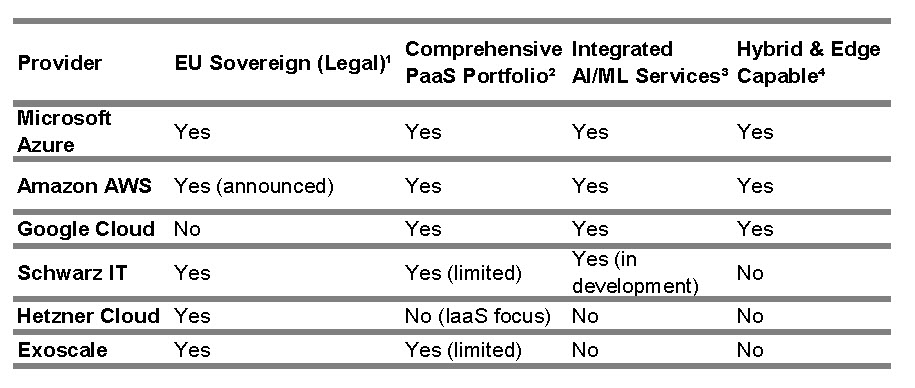
¹ EU Sovereign (Legal): Data infrastructure and operator are subject to EU law. US hyperscalers use trustee or separate entity models.
² Comprehensive PaaS Portfolio: Availability of managed services (e.g., databases, Kubernetes).
³ Integrated AI/ML Services: Ready-to-use services for Machine Learning and AI.
⁴ Hybrid & Edge Capable: Support for distributed workloads between on-premises, edge, and cloud.
What Can European Cloud Alternatives like Schwarz, Hetzner, or Exoscale Already Do Today?
Purely European cloud providers are not 1:1 copies of hyperscalers. They currently focus on the foundation.
Focus and Strength of European Providers:
- Core Infrastructure (IaaS): High-performing and attractively priced virtual machines, networks, and storage from providers like Hetzner, Schwarz IT, or Exoscale.
- Container Platforms (CaaS): Excellent managed Kubernetes services. Applications in Docker containers can be operated seamlessly on these sovereign platforms, creating flexibility and independence.
- Focused PaaS Offerings: Established services for standard applications like managed databases (PostgreSQL, MySQL) or load balancers.
The Difference to Traditional Hyperscalers:
The main difference lies in the scope of the service portfolio. While hyperscalers like AWS, Azure, or Google offer thousands of highly specialized services for almost every conceivable problem, European providers concentrate on core building blocks.
You will less often find:
- A huge marketplace with hundreds of third-party SaaS solutions.
- Highly specialized, ready-to-use AI/ML services for image recognition, text analysis, etc.
- Complex big data analysis platforms as a finished service.
- This requires more self-effort but also offers more control.
How to Get Started as a Mid-Sized Manufacturer?
As a mid-sized company, especially in the manufacturing industry, the path to a European cloud requires a pragmatic approach:
- Clear Needs Analysis:
- Data Inventory: Which data (production plans, CAD, customer data) is critical?
- Application Review: Which systems (ERP, MES, IoT, archive) should move to the cloud?
- Compliance Requirements: Besides GDPR, TISAX, ISO 27001, etc., are also relevant.
- Economic Viability Assessment (TCO & ROI): What short- and long-term costs arise (licenses, migration, training) and what benefits are achieved (hardware savings, increased flexibility, faster innovation)?
- Start a Pilot Project:
- Choose a manageable use case (e.g., an IoT project, test system migration, or secure data archiving).
- Gain initial experience and understand the technical and organizational processes involved in using the cloud.
- Leverage Expertise:
- Internal IT is often at capacity. External specialists with industry knowledge are crucial.
- They help with requirements definition, provider selection, and integration into existing systems.
Here's what your project could look like: AI Entry into Production with a Hybrid Cloud
A manufacturing company at the beginning of its digitalization journey wanted to unlock the potential of AI. The goal: quickly search plant documentation in case of failure and analyze machine data with Machine Learning. A hybrid approach was chosen, comprehensive plant documentation remains local with the customer. Only queries to the Large Language Model (LLM) are sent to a cloud infrastructure for AI processing. Similarly, sensitive production and quality data remain local in the STIWA Shopfloor System. Only selected, anonymized data for targeted ML calculations are transferred to an infrastructure provided by Dataciders. This approach ensures maximum data sovereignty while maintaining the flexibility to switch cloud providers or ML models at any time to adapt to changing requirements.
Conclusion: Strategy over Generic Solution: Sovereignty as a Differentiator
Most hyperscalers have "done their homework" and offer viable sovereign solutions. However, the assumption that a Sovereign Cloud is only worthwhile for highly regulated industries is too simplistic. Costs may be higher, but the decision must be viewed in the business context:
- Encryption alone is not a solution for sovereignty: It protects data but not against access by foreign jurisdictions. Sovereignty addresses precisely this legal access possibility.
- The Value of Intellectual Property: Many companies possess valuable IP. Protecting this from unauthorized access can far outweigh the costs of a Sovereign Cloud.
- Customer Trust and Competitive Advantage: Transparent communication about data-sovereign solutions can be a decisive trust factor and competitive advantage.
- It's about developing a tailored cloud strategy that offers the right level of sovereignty for the respective data and applications. A hybrid approach is often the optimal path.
Your Path to your ideal Cloud solution: Contact Us!
For a targeted strategy and the secure implementation of your journey to a Smart Factory, STIWA Software and Dataciders are at your side as experienced partners. We support you from analysis to integration, customized for your company's challenges, from data acquisition to intelligent analysis and control.
When is the right time to contact us?


Would you like to learn more? We are here for you!