
Picture a factory floor 50 years ago. The smell of oil hangs in the air, the rhythmic pounding of machines sets the pace. And right in the middle of it all: a foreman with a clipboard, a stopwatch, and a tally sheet. The information was valuable, but it was slow to collect, tedious, and often inaccurate. Decisions were based on experience and gut feelings.
Those days are over. But the path to today's data-driven "smart factory" wasn't a sudden leap; it was a fascinating evolution. This is the story of three developmental stages that built upon each other to forever change the way physical goods are produced: Machine Data Acquisition (MDA), Production Data Acquisition (PDA), and Quality Data Acquisition (QDA).
Chapter 1: The First Heartbeat – The Birth of Machine Data Acquisition (MDA)

In the 1970s and 80s, with the advent of the first Programmable Logic Controllers (PLCs), machines began to learn a rudimentary language. The manual tally sheet could no longer keep up with the speed of automation. The central question was: Is the machine running or is it down?
This was the birth of Machine Data Acquisition (MDA).
- The Focus: Purely on the machine. Counters for produced parts, sensors for downtime, and simple fault codes were pulled directly from the machine controller.
- The Benefit: For the first time, there was an objective, automated view of pure machine uptime and output. You could see when a machine was down, but barely why.
- The Limitation: MDA was like an EKG that only measures the heartbeat. It didn't know which patient (order) was being treated, which doctor (employee) was on duty, or whether the treatment (quality) was successful. The context was missing.
Chapter 2: Seeing the Big Picture – The Expansion to Production Data Acquisition (PDA)

By the late 1980s and well into the 1990s, the realization slowly sank in: a machine rarely operates in a vacuum. To truly understand efficiency, you had to look at the entire operational process. The question was no longer just "Is the machine running?" but "Who is working on which order, and how long does it really take?"
This is where Production Data Acquisition (PDA) enters the stage.
- The Focus: PDA expanded the view from the machine to the entire order process. It integrated people and the organization. Employees logged in and out of jobs at terminals, and material consumption was recorded.
- The Benefit: Suddenly, connections became visible. You could not only see machine downtimes (from MDA) but also assign them to causes like "material missing" or "waiting for personnel" (from PDA). True cost calculation for jobs became possible.
- The Limitation: You now knew how fast and with what effort you were producing. But was the result any good? The question of product quality remained largely a separate discipline at the end of the production line.
Chapter 3: Quality as a Currency – The Specialization in Quality Data Acquisition (QDA)
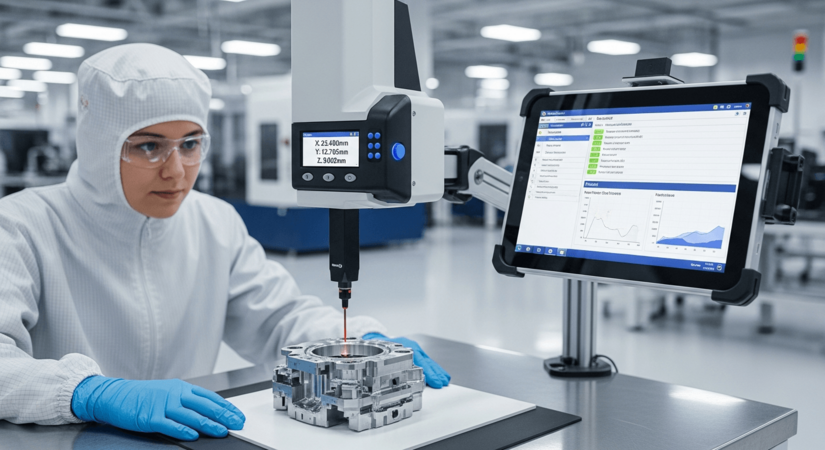
While quality control itself has existed for decades, digital Quality Data Acquisition systems became widespread in the mid-1990s and solidifying into the early 2000s. With rising customer demands and increasing cost pressure from scrap and rework, it became unequivocally clear: quality is not a coincidence. It is a critical factor that must be systematically measured, monitored, and controlled directly within the production process. The crucial question became: "Are we producing not only fast, but also right, consistently, and without defects?" This imperative led to the rise of
Quality Data Acquisition (QDA) as the indispensable third pillar of modern manufacturing data.
- The Focus: Systematic collection of quality-relevant data directly within the process. This included measurements from testing equipment, results from operator self-checks, defect catalogs, and Statistical Process Control (SPC).
- The Benefit: Instead of finding defects at the end, they could now be detected and prevented early on. The traceability of batches was ensured, and the root causes of quality problems could be systematically analyzed.
- The Limitation (in Isolation): Without a connection to PDA and MDA, quality data remained just one piece of the puzzle. A quality issue could be recorded, but the automatic reaction—for example, stopping the affected machine—was not readily possible.
To truly understand the power of MDA, PDA, and QDA, it is essential to look beyond definitions and examine their technical architecture, data flows, and system interactions within a modern manufacturing environment.
Machine Data Acquisition (MDA): The Real-Time Signal Layer
MDA operates at the lowest level of the automation stack, directly interfacing with machines and control systems. Its primary role is to capture high-frequency, real-time signals that describe the physical behavior of equipment.
- Typical Data Collected:
- Machine states (e.g., running, idle, fault, setup)
- Cycle times and cycle counters
- Alarm and fault codes
- Process parameters (temperature, pressure, torque, vibration)
- Energy consumption and load profiles
- Data Sources:
- PLCs (e.g., Siemens S7, Beckhoff)
- CNC controllers
- Embedded machine controllers
- Retrofitted sensors (IIoT gateways, edge devices)
- Communication Technologies:
- OPC UA (industry standard for interoperability)
- Modbus TCP/RTU
- Profinet / EtherNet/IP
- MQTT (in modern IIoT architectures)
- Proprietary protocols (machine-specific)
- Architecture Considerations:
- Edge computing is often used to preprocess signals (filtering, aggregation, event detection)
- High data volumes require buffering and efficient transport mechanisms
- Time synchronization (e.g., NTP) is critical for cross-machine analysis
Production Data Acquisition (PDA): The Context and Transaction Layer
PDA sits above MDA and introduces semantic meaning and transactional context to raw machine data. It connects physical events to orders, people, and materials, effectively bridging the gap between automation and business systems.
- Typical Data Collected:
- Production orders and operations (from ERP)
- Operator identification and shift information
- Start/stop bookings for jobs
- Scrap quantities and rework declarations
- Downtime reasons (manual classification)
- Material consumption and batch tracking
- Data Sources:
- Operator terminals (HMI panels, industrial PCs)
- Barcode/RFID scanners
- Mobile devices (tablets, handhelds)
- ERP systems (e.g., SAP)
- Interaction Mechanisms:
- Manual input (touch, keyboard)
- Semi-automated triggers (e.g., machine state → operator confirmation)
- Automatic bookings based on rules (e.g., cycle count → production quantity)
- System Integration:
- Tight coupling with ERP systems (order download, feedback loops)
- Synchronization with MES core data models (routing, work centers, BOM)
- Architecture Considerations:
- Event-driven design (e.g., job start triggers data collection)
- Data validation and plausibility checks (e.g., scrap vs. produced quantity)
- Latency is less critical than in MDA, but consistency is key
Quality Data Acquisition (QDA): The Compliance and Insight Layer
QDA focuses on capturing and analyzing quality-relevant data to ensure that production outputs meet defined specifications. It operates both in-process (real-time) and post-process (inspection-based).
- Typical Data Collected:
- Measurement values (dimensions, weight, tolerances)
- Test results (pass/fail, functional tests)
- Defect codes and classifications (product and process codes)
- Process capability indices (Cp, Cpk)
- Audit and inspection records
- Data Sources:
- Measurement devices (calipers, micrometers, gauges)
- Coordinate Measuring Machines (CMM)
- Vision systems and AI-based inspection
- Integrated test benches and end-of-line testers
- Manual input from quality personnel
- Analytical Methods:
- Statistical Process Control (SPC)
- Control charts (X-bar, R, p, np)
- Trend analysis and drift detection
- Rule-based alerts
- Root cause analysis (linked to MDA/PDA data)
- Statistical Process Control (SPC)
- Integration Points:
- Linkage to production orders (PDA)
- Correlation with machine parameters (MDA)
- Feedback loops for process adjustment (closed-loop quality control)
- Architecture Considerations:
- Traceability (genealogy tracking: material → process → result)
- Data integrity and compliance (e.g., ISO 9001, IATF 16949)
- Storage of large datasets (e.g., measurement series)
Summary
- MDA = Signals
- PDA = Context
- QDA = Validation
Only together do they form a closed-loop system capable of real-time optimization, traceability, and continuous improvement.
The Synthesis: When It All Comes Together – The Modern MES
Each of these developments was revolutionary on its own. But they only unleash their full potential when they no longer exist as separate "data islands" but are seamlessly integrated.
Today's answer to this is an integrated Manufacturing Execution System (MES).
A modern MES is the central nervous system of the factory. It's the place where...
- ...MDA provides the real-time pulse of the machines.
- ...PDA places this pulse into the context of orders, personnel, and materials.
- ...QDA ensures that the output is not only fast but also flawless.
When a quality problem (QDA) occurs, the system can automatically stop the machine (MDA) and update the status of the order (PDA). This is the true power of digital transformation in manufacturing.
The journey from the clipboard to the smart factory clearly shows one thing: it's not just about collecting data, but about intelligently connecting it to make better decisions. MDA, PDA, and QDA are no longer separate disciplines, but the inseparable building blocks of a transparent, efficient, and high-quality production environment.
Where are you on this evolutionary journey? Are you still using individual tally sheets, or is your data already fully connected?
If you're ready to take the next step and unleash the full potential of your production, talk to our experts. We'll show you how a STIWA Software can future-proof your manufacturing operations.
Would you like to learn more? We are here for you!