A central pillar of modern manufacturing is an MES (Manufacturing Execution System). This system serves as the control center for many production processes, manages key information, and ensures smooth order planning. But is a traditional MES always sufficient? Or is there still more potential for optimization right at the machine?
MES systems essentially bridge the gap between a company's commercial level, represented by the ERP system, and the physical production on the shop floor. Their tasks are diverse, typically including managing production orders, tracking materials, planning personnel, managing quality, and capturing key performance indicators such as overall equipment effectiveness (OEE). They are indispensable tools that help create transparency and optimize coordination in complex manufacturing environments. They enable those responsible to gain an overview of production status, identify bottlenecks, and make basic control decisions.
Undoubtedly, MES Software has brought immense benefits to production planning and control. They have improved the efficiency of many processes by automating manual tasks and increasing data availability. However, despite these strengths, traditional MES Software approaches often reach their limits when it comes to in-depth analysis and optimization of actual machine processes.
The problem often lies in data depth and timeliness. Many MES systems work with aggregated data collected via various interfaces or, often, even through manual entries. This abstraction layer above the machine level can cause important details to be lost. If data is not available in real time and at the highest granularity, precise root cause analyses of production problems can be hindered or delayed. You might know that a downtime occurred, but not exactly why or which parameter deviated at that moment. This often leads to "guesswork" that costs time and prevents rapid problem resolution. Furthermore, reliance on middleware placed between the machine and the MES can introduce additional complexity and potential sources of error.

An MES remains an essential component of production management. However, the extensive data generated directly on the shop floor by PLCs and production equipment often falls outside the scope of such systems. Therefore, for further optimization, a new approach is needed.
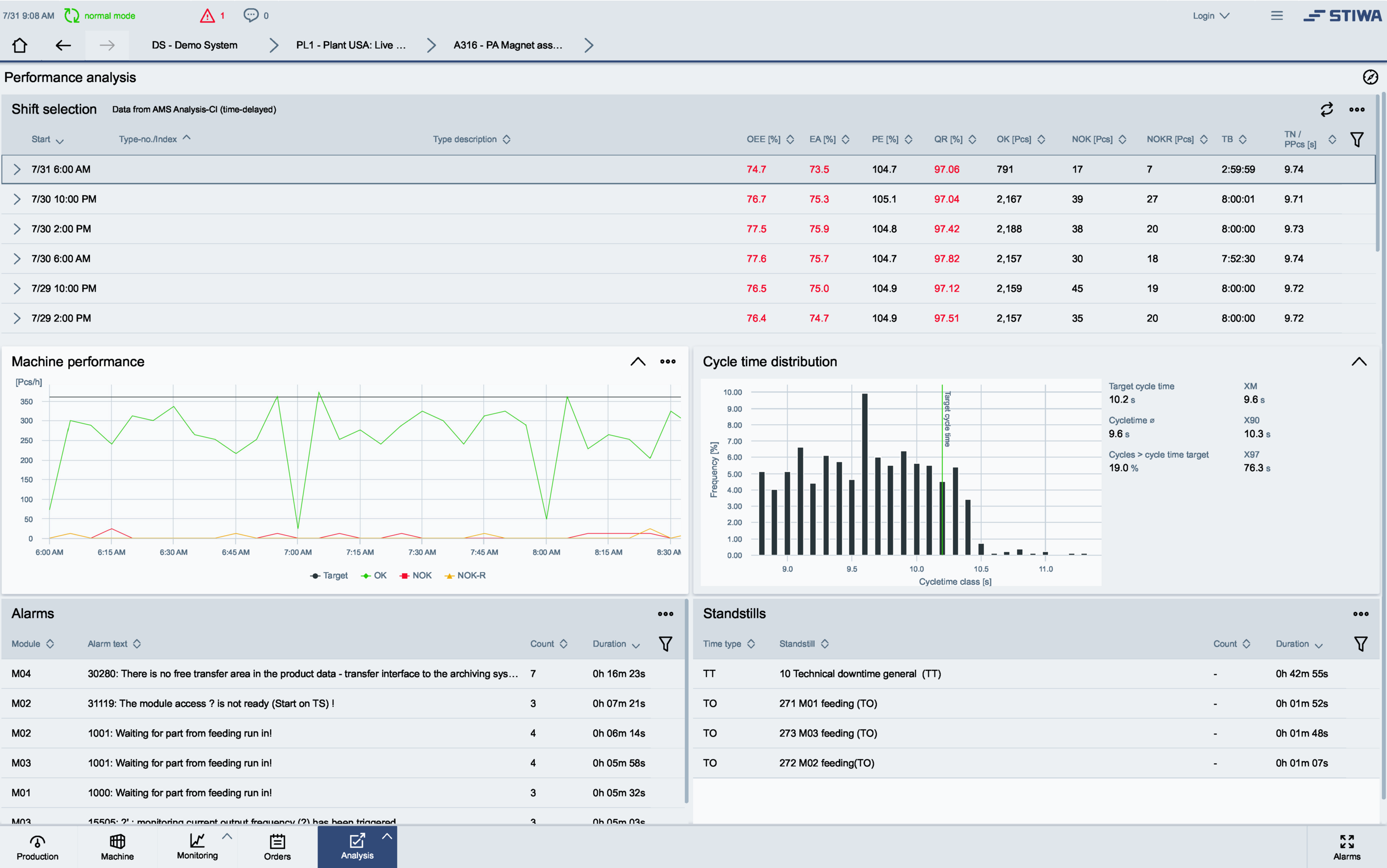
Recognizing the need for a new approach to unlock deeper optimization beyond traditional MES capabilities. The core strength of STIWA Shopfloor Software lies in in-depth data acquisition directly at the machine. Operating at the machine and control (PLC) level enables real-time data capture without the reliance on additional middleware. This direct connection provides a crucial advantage: it not only bypasses the complexity and latency often associated with intermediate layers but also guarantees an unprecedentedly detailed and real-time data foundation. Every machine movement, production cycle, measured parameter, and process deviation is captured directly and authentically at the source.
What this high-quality, direct machine data enables is transformative:
-
Precise Production Control: With such detailed insight into machine processes, you can not only monitor production but also actively and precisely control it.
-
Granular Error Analysis & Trustworthy Downtime Categorization: Instead of just knowing that a problem occurred, you find out exactly when, which machine parameter deviated, and why a malfunction happened. This significantly accelerates root cause analysis and allows for much faster resolution. Furthermore, this direct data enables automatic detection of standstill root causes from the machine's alarm list, categorizing downtime reasons without operator intervention, ensuring your downtime reasons are always trustworthy.
-
Early Escalation Management: The real-time nature and granularity of the data allow for immediate identification of emerging issues or deviations from target parameters. This triggers early, automated escalation processes, ensuring that critical problems are flagged to the right personnel instantly and enabling proactive intervention before minor issues become major disruptions.
- Holistic Root Cause Identification: By seamlessly overlaying and correlating raw Machine Data, Production Data (e.g., job orders, personnel shifts), and Quality Data (e.g., test results, defect rates) in a unified view, STIWA Shopfloor Software reveals complex interdependencies and hidden root causes that would be impossible to detect through manual observation or isolated data analysis. This exposes insights into systemic issues affecting quality or efficiency that were previously invisible.


For which companies is this new perspective now critical? This approach is critical for any manufacturer looking to maximize production efficiency, but particularly for those facing following challenges:
- Companies grappling with inefficiencies: If production delays, unplanned machine downtimes, and difficulties in root cause analysis dominate daily production, STIWA Shopfloor Software provides the necessary insights to systematically address these issues and regain control over production.
- Companies with insufficient data depth: If the current MES Software provides data, but it's not granular enough to derive concrete improvements or find precise errors, then machine-level data acquisition delivers the missing information.
- Companies looking to end "guesswork": If decisions on the shop floor are often based on experience, gut feeling, or incomplete reports, rather than hard, current data, then the software enables informed, data-driven decision-making.
- Companies striving for full control over their production: If the goal is to identify and resolve problems faster and make informed decisions that deliver real results, then deep machine data integration is essential.
- Companies investing in the future: The software establishes the precise, high-resolution data foundation required for AI-driven analytics, machine learning, and predictive maintenance. Without high-quality, machine-level, real-time data, these forward-looking technologies cannot be effectively deployed.
Traditional MES systems remain an essential part of modern production, providing the foundation for planning, execution, and production management. However, greater transparency and better decision-making depend on the quality and depth of the data available.
Developed from decades of experience in automation and manufacturing, STIWA Shopfloor Software was created to capture production data where it originates—directly at the machine. By providing a more complete and reliable data foundation, manufacturers gain deeper process insights, respond more quickly to issues, and make better-informed decisions across their production environment.
Rather than replacing an MES, this machine-centric approach strengthens the entire digital manufacturing ecosystem, helping manufacturers improve productivity, quality, and operational efficiency.
Stop wondering why your machines stop. Request a hands-on Proof of Value to see exactly how direct PLC data integration can uncover hidden capacity in your facility.
Would you like to learn more? We are here for you!