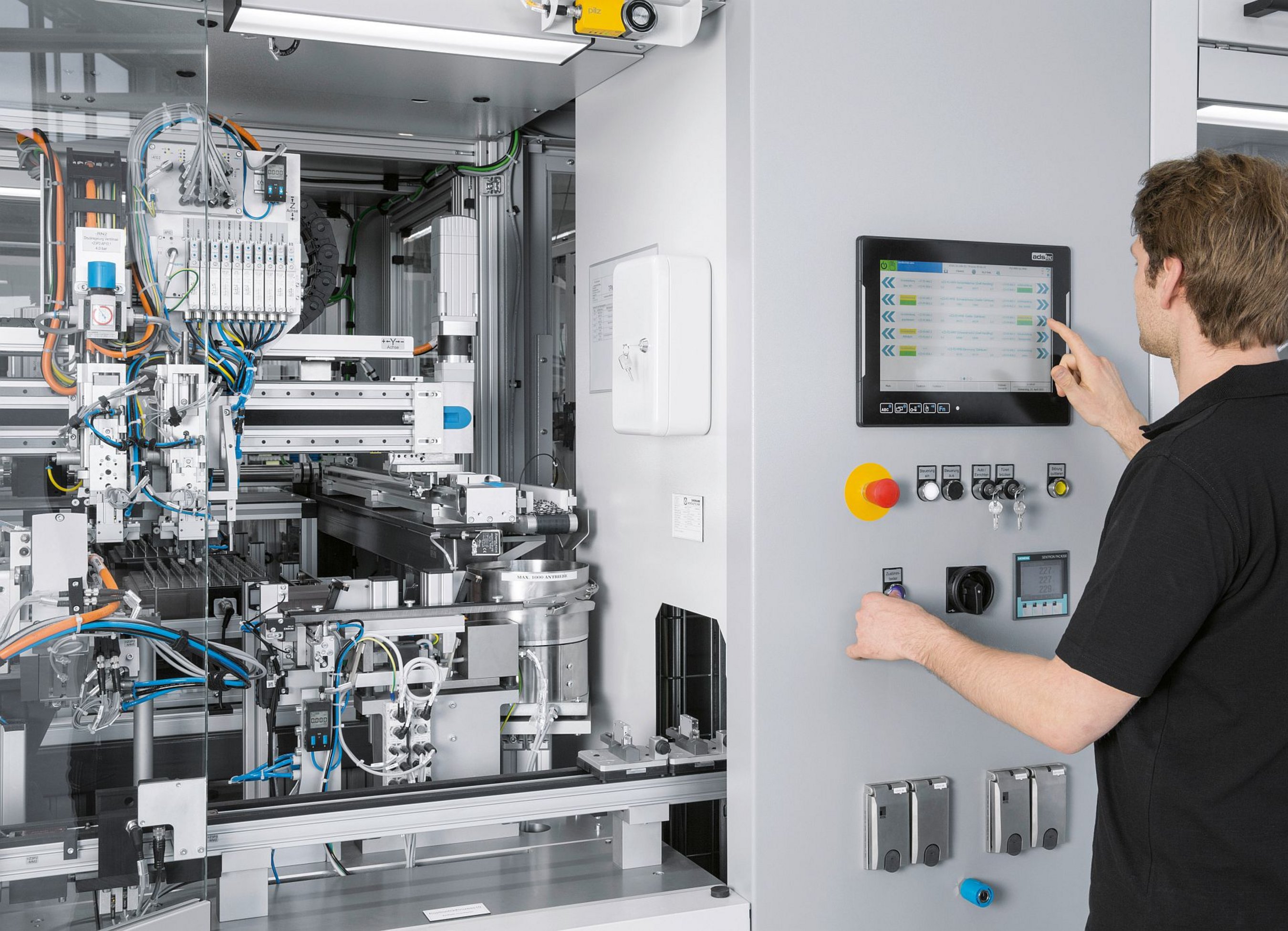

Facing increased customer demand, Festo sought to improve the efficiency of a critical production machine. This initiative led to the formation of a dedicated interdisciplinary team, including their plant manufacturer and experts from Festo and STIWA. By deploying STIWA's specialized analysis software, the team identified key optimization potentials, implemented precise adjustments, and ultimately achieved a significant and sustained increase in Overall Equipment Effectiveness (OEE).
Festo, a global leader in industrial and process automation, continuously innovates with its technological developments and more than 30,000 catalog products in several hundred thousand variants. At its Technology Plant in Scharnhausen, increased customer demand required a significant increase in OEE for a VUVG automation system that produces thousands of pneumatic valves daily. "At the time, we were also struggling with unstable production processes at the plant," reports Festo project manager Kilian Seiler. "Our goal was to quickly identify and eliminate the problem areas to achieve a sustained and significant increase in output. For this purpose, we set up an interdisciplinary optimization team... which worked exclusively on this project."
The Power of Automation and Software Know-How
The analysis was led by automation specialist STIWA, whose software products AMS ZPoint-CI and AMS Analysis-CI are integral to Festo's machines. "For more than 25 years, we have relied on the data recording and analysis of all motions of the machines," explains Peter Reisinger, Head of Application Technology Projects at STIWA Software in Hagenberg. “Scalable and adaptable analysis tools enable us to recognize complex interrelationships in production, limit weak points and thereby achieve performance increases.”
Pinpointing Inefficiencies with Data
For several weeks, Reisinger and experts from process technology, control engineering, and quality management closely examined the plant's individual production processes. "STIWA's task was to provide a well-founded database and to identify optimization potential in the areas of performance, availability and quality," notes Reisinger. The technical analyses revealed that a combination of technical, mechanical, and organizational issues was causing numerous cycle time overruns. Specific causes included faulty feeding material and incorrectly set screwing, press-in, and handling processes, which led to long block times, increased scrap, and module standstills.
A Continuous Increase in Output
Based on the evaluated data material of the individual production steps, the optimization team made adjustments in the areas of control and quality engineering, process technology, organization and mechanics. Measures included the reduction of holding and cleaning times, the optimization of gripper units and screwing programs, the exchange of materials used, changes in software parameters and maintenance.
The effects of the implemented measures were then revalidated. Within a few weeks, the OK output of the plant was increased by more than 10 %. The reject rate was reduced significantly. After one year, the rate of increase in OK output had already reached 40%.